Overview
Kausani is a small hill village at about 1,890 metres on a ridge in Bageshwar district, in the Kumaon region of Uttarakhand, famous for one of the widest views of the Himalaya anywhere: a panorama of some 300 km of snow peaks, from Trishul and Nanda Devi to Panchachuli. Surrounded by pine forests, tea gardens and terraced villages, it has long drawn thinkers and writers, from Mahatma Gandhi, who stayed here in 1929, to the Hindi poet Sumitranandan Pant, who was born here. It is a peaceful base for walks, Kumaoni village life and the temples of the Katyur valley below.
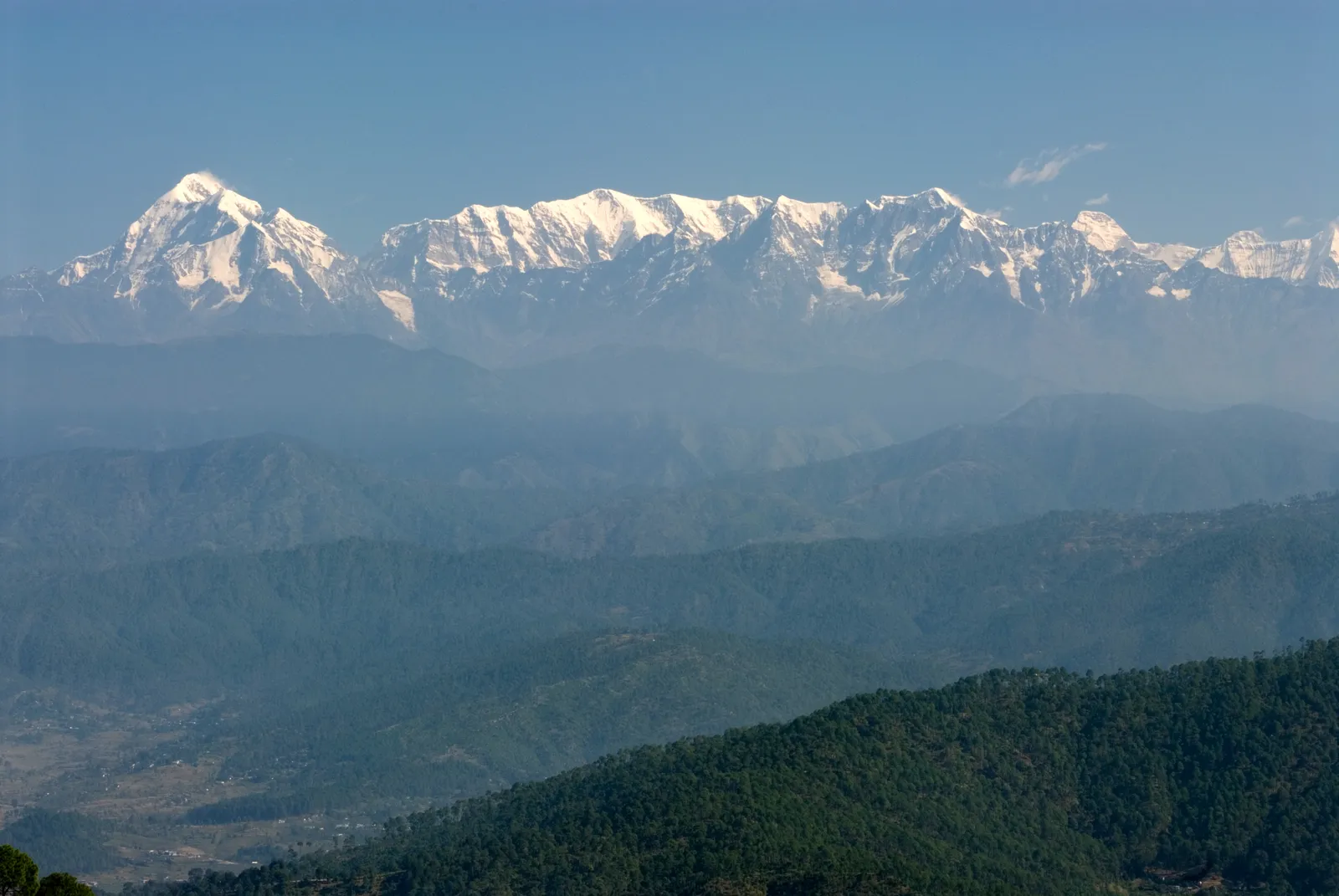
Kausani. Sanjoy (Flickr), via Wikimedia Commons, CC BY 2.0.
At a glance
Why visit Kausani?
Few places in the Indian Himalaya offer such a broad view of the snow peaks from a quiet village: at sunrise, the whole range glows pink and gold across the valley. Beyond the view, Kausani offers forest and tea-garden walks, the ashrams associated with Gandhi and Sarala Behn, the home of a great Hindi poet, and easy trips to the medieval temples of Baijnath and the market town of Bageshwar.
Best known for
- A panoramic view of some 300 km of the Himalaya.
- Anashakti Ashram, where Gandhi stayed in 1929.
- The birthplace and museum of the poet Sumitranandan Pant.
- Lakshmi Ashram, founded by Sarala Behn.
- Tea gardens and shawl weaving.
- The temples of Baijnath in the valley below.
Who will enjoy it?
| Traveller type | Suitability | Why |
|---|---|---|
| Photographer | Excellent | Sunrise on the Himalayan range |
| Slow traveller | Excellent | Quiet walks and homestays |
| History and literature lover | Very good | Gandhi and Sumitranandan Pant |
| Family | Very good | Gentle walks and views |
| Traveller with limited mobility | Fair | Hilly lanes and steps |
Historical and cultural context
In 1929, Mahatma Gandhi spent about two weeks in Kausani during a tour of Kumaon, staying in a guesthouse that is now the Anashakti Ashram; here he wrote his introduction to Anasakti Yoga, his commentary on the Bhagavad Gita, and he praised the beauty of the view, comparing it to Switzerland. The poet Sumitranandan Pant, one of the leading figures of modern Hindi poetry, was born in Kausani in 1900, and his family home is now a museum.
In 1946, Catherine Mary Heilemann, an English follower of Gandhi known as Sarala Behn, founded the Lakshmi Ashram near Kausani to educate girls from the hills; she and the ashram played an important part in Uttarakhand's environmental movements, including the campaigns that inspired the Chipko movement. The valley below, the Katyur valley, was the seat of the Katyuri kings of Kumaon, who built the temples of Baijnath.
Life in the villages
The villages around Kausani grow wheat, millets, rice in the valleys, potatoes, vegetables and fruit on terraced fields, and keep cattle and goats. Women do much of the farming and gather fodder and firewood from the forests. Tea is grown on estates near the village, and shawls and woollens are woven in cooperatives. Many young people leave for work in the plains, and tourism, homestays and handicrafts help families earn a living at home.
Top experiences
- Watch sunrise and sunset over the Himalayan range.
- Visit the Anashakti Ashram and its small museum.
- See the Sumitranandan Pant museum.
- Walk through the tea gardens and pine forests.
- Visit the Lakshmi Ashram and learn about its work.
- Make a trip to the Baijnath temples and Bageshwar.
What to see
The Himalayan panorama
The view from the ridge takes in Trishul, Nanda Devi, Nanda Kot, Panchachuli and many other peaks; mornings in autumn and winter are clearest.
Anashakti Ashram
The guesthouse where Gandhi stayed, now an ashram with a prayer hall, a small museum of photographs and a peaceful garden facing the mountains.
Sumitranandan Pant museum
The poet's family home, with his manuscripts, letters, books and personal belongings.
Lakshmi Ashram
The ashram founded by Sarala Behn, still working on girls' education and village development; visitors can learn about its history by arrangement.
The tea estate
Tea gardens near the village, where visitors can see the plantation and buy local tea.
Baijnath
A group of stone temples of the Katyuri period beside the Gomti river, about 19 km away, dedicated to Shiva and other deities. The main temple holds a fine image of Parvati carved in black stone, and the riverside setting, with steps down to the water and fish in the pools, is peaceful. Nearby, the Katyur valley's fields stretch towards the hills, and the old town of Baijnath was once the Katyuri capital.
Food and drink
Guesthouses and homestays serve Kumaoni dishes such as bhatt ki churkani, aloo ke gutke, madua rotis and raita, along with North Indian food. Kumaoni sweets such as bal mithai are found in nearby towns.
Shopping and local craft
Buy shawls and woollens from the weavers' cooperatives, Kausani tea, local honey and Aipan art.
Money and costs
| Item | Current guidance | Confidence |
|---|---|---|
| Guesthouses | Prices rise in peak seasons | Live quote |
| Museums and ashram | Free or small fees | Live check required |
| Taxis | For Baijnath and Bageshwar | Live quote |
Accommodation
| Stay type | Best for | Location logic | What to verify before booking |
|---|---|---|---|
| Hotel facing the peaks | Views | On the ridge | Room orientation and heating |
| Village homestay | Slow travellers | Villages around Kausani | Access and meals |
| Ashram guesthouse | Quiet stays | Anashakti Ashram | Rules and availability |
Facilities, accessibility and comfort
- Views depend on clear weather; hazy summer days and the monsoon may hide the peaks.
- Winter nights are cold; ask about heating.
- Roads are winding; motion sickness is common.
- The ashrams expect quiet and respectful behaviour.
- Binoculars help pick out individual peaks; many hotels have charts naming them.
Getting there and around
Kausani is in Bageshwar district, Kumaon, Uttarakhand, about 50 km from Almora.
By air
Pantnagar airport, about 170 km away, has limited flights.
By rail
Kathgodam, about 135 km away, is the nearest railhead, with trains from Delhi.
By road
Roads from Kathgodam via Almora or via Bhowali and Ranikhet reach Kausani in about five hours; buses and shared taxis run.
Local movement
Walk in the village and to the ashrams; taxis for Baijnath and Bageshwar.
Planning the visit
October to February offers the clearest views, with cold nights in winter; March to June is pleasant, with rhododendrons in spring; the monsoon, from July to September, brings clouds and landslides. The Uttarayani fair at Bageshwar in January is a major event in the region.
Suggested itineraries
Two days
Sunrise on the ridge, the Anashakti Ashram and Pant museum on day one; the tea estate and Baijnath on day two.
A Kumaon circuit
Combine Kausani with Almora, Binsar and Munsiyari.
Nearby connections
| Destination | Approximate relationship | Why combine |
|---|---|---|
| Almora | About 50 km | Kumaon hill town and villages |
| Munsiyari | About 150 km | Panchachuli peaks |
| Baijnath | About 19 km | Katyuri temples |
| Bageshwar | About 40 km | Confluence town and fair |
Study notes
- Read Gandhi's commentary on the Gita, written partly in Kausani.
- Learn about Sarala Behn and the environmental movements of Uttarakhand.
- Read the nature poetry of Sumitranandan Pant.
- Compare the Katyuri temples of Baijnath with those of Jageshwar.
Responsible visit
Stay in local homestays, buy from cooperatives, keep forests and trails clean, and respect the ashrams' quiet.
Reality check
Kausani is small and quiet, with simple facilities, and the view is weather-dependent. Plan for at least two mornings to see the peaks.
Sources
- Uttarakhand Tourism
- Kumaon Mandal Vikas Nigam (KMVN)
- Anashakti Ashram and Lakshmi Ashram